Aviation Abbreviations: A Practical Quick Reference Guide
July 22, 2026
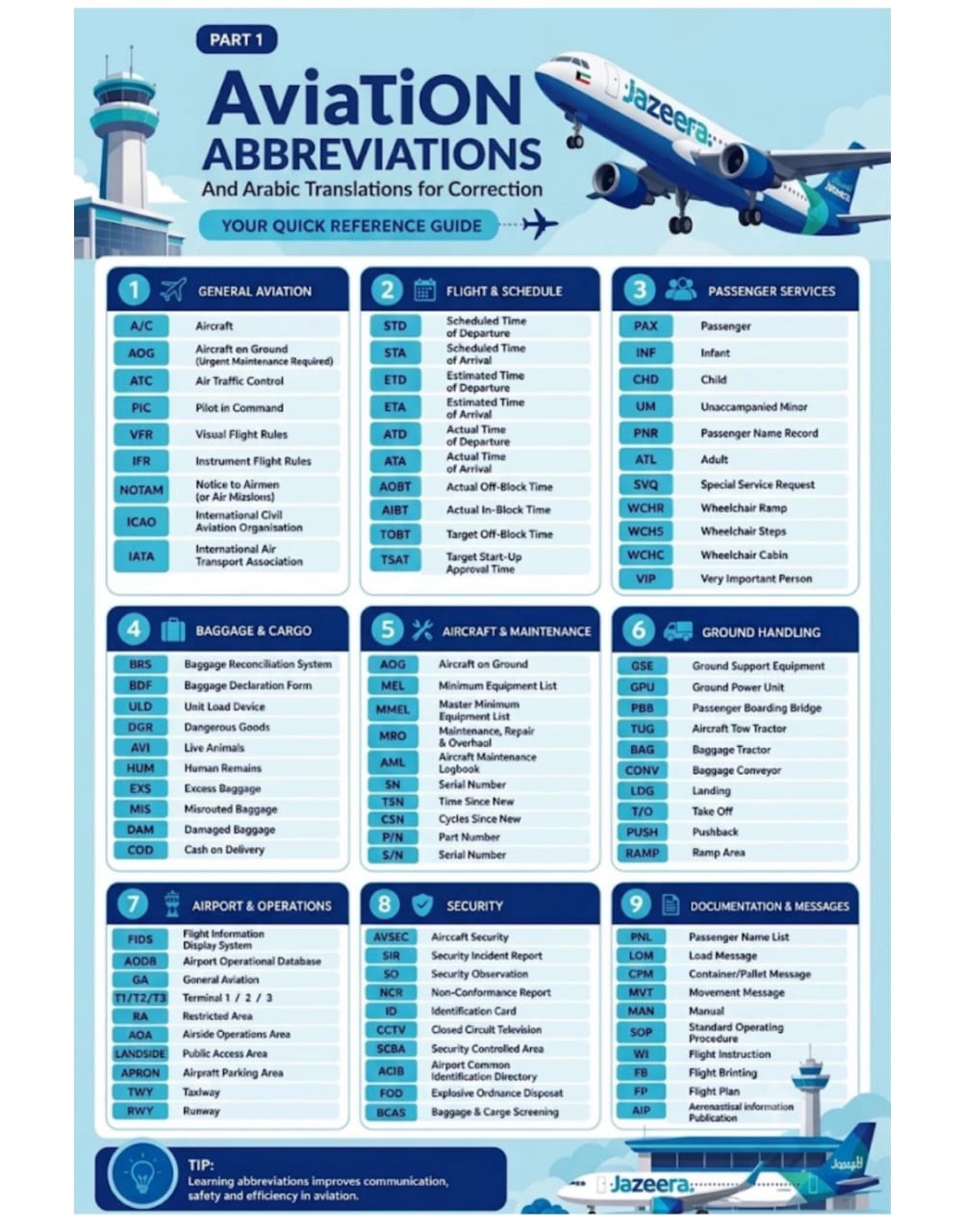
Aviation runs on precision, and abbreviations help everyone from pilots to ground staff communicate faster and more clearly. This quick reference covers common terms used across flight operations, passenger handling, baggage, security, and airport services.
Why abbreviations matter
In aviation, a short code can carry a lot of meaning. That saves time on radios, in manuals, in flight plans, and during daily airport operations. It also reduces confusion when teams across different functions need to work together quickly.
For anyone studying airport operations or airline procedures, learning these abbreviations is a strong foundation. They appear in operational messages, load sheets, NOTAMs, scheduling systems, and ramp communications.
General aviation terms
These are some of the most widely used abbreviations in flight operations:
A/C: Aircraft.
AOG: Aircraft on Ground.
ATC: Air Traffic Control.
PIC: Pilot in Command.
VFR: Visual Flight Rules.
IFR: Instrument Flight Rules.
NOTAM: Notice to Airmen.
ICAO: International Civil Aviation Organization.
IATA: International Air Transport Association.
These terms are core to aviation communication and appear frequently in both operational and regulatory contexts.
Flight and schedule terms
Scheduling abbreviations are used daily in airline systems and airport coordination:
STD: Scheduled Time of Departure.
STA: Scheduled Time of Arrival.
ETD: Estimated Time of Departure.
ETA: Estimated Time of Arrival.
ATD: Actual Time of Departure.
ATA: Actual Time of Arrival.
AOBT: Actual Off-Block Time.
AIBT: Actual In-Block Time.
TOBT: Target Off-Block Time.
TSAT: Target Start-Up Approval Time.
For ground operations and airline control teams, these codes help track the movement of flights from gate to runway and back.
Passenger service terms
Passenger handling relies on standard abbreviations to identify customer needs quickly:
PAX: Passenger.
INF: Infant.
CHD: Child.
UM: Unaccompanied Minor.
PNR: Passenger Name Record.
ATL: Adult.
SVQ: Special Service Request.
WCHR: Wheelchair Ramp.
WCHS: Wheelchair Steps.
WCHC: Wheelchair Cabin.
VIP: Very Important Person.
These abbreviations are especially important in check-in, boarding, gate handling, and special assistance coordination.
Baggage and cargo terms
Cargo and baggage teams use shorthand to classify goods and track irregularities:
BRS: Baggage Reconciliation System.
BDF: Baggage Declaration Form.
ULD: Unit Load Device.
DGR: Dangerous Goods.
AVI: Live Animals.
HUM: Human Remains.
EXS: Excess Baggage.
MIS: Misrouted Baggage.
DAM: Damaged Baggage.
COD: Cash on Delivery.
These terms support safe handling, load planning, and baggage accountability throughout the journey.
Aircraft and maintenance terms
Aircraft engineering and reliability work depend on precise maintenance codes:
MEL: Minimum Equipment List.
MMEL: Master Minimum Equipment List.
MRO: Maintenance, Repair & Overhaul.
AML: Aircraft Maintenance Logbook.
SN: Serial Number.
TSN: Time Since New.
CSN: Cycles Since New.
P/N: Part Number.
S/N: Serial Number.
These abbreviations are widely used in maintenance records, technical logs, and defect reporting.
Airport operations terms
Airport-side operations have their own common shorthand:
FIDS: Flight Information Display System.
AODB: Airport Operational Database.
GA: General Aviation.
T1/T2/T3: Terminal 1 / 2 / 3.
RA: Restricted Area.
AOA: Airside Operations Area.
LANDSIDE: Public Access Area.
APRON: Aircraft Parking Area.
TWY: Taxiway.
RWY: Runway.
These are essential for airside coordination, terminal flow, and operational planning.
Security and documentation
Security teams and document control also rely on standard codes:
AVSEC: Aircraft Security.
SIR: Security Incident Report.
SO: Security Observation.
NCR: Non-Conformance Report.
ID: Identification Card.
CCTV: Closed Circuit Television.
SCBA: Self-Contained Breathing Apparatus.
ACI: Airport Common Identification Directory.
FOD: Foreign Object Debris/Disposal.
BCAS: Bureau of Civil Aviation Security.
Documentation abbreviations are also common in flight operations and messaging:
PNL: Passenger Name List.
LDM: Load Message.
CPM: Container/Pallet Message.
MVT: Movement Message.
MAN: Manual.
SOP: Standard Operating Procedure.
WI: Work Instruction.
FB: Flight Briefing.
FP: Flight Plan.
AIP: Aeronautical Information Publication.
Learning aviation abbreviations is not just about memorizing codes. It helps improve communication, safety, coordination, and speed across the entire airport ecosystem. For students and professionals in aviation, this kind of reference can become a daily operational tool.https://www.worldptc.com/ground-staff