Why don’t aircraft fly over Tibet?
October 06, 2026
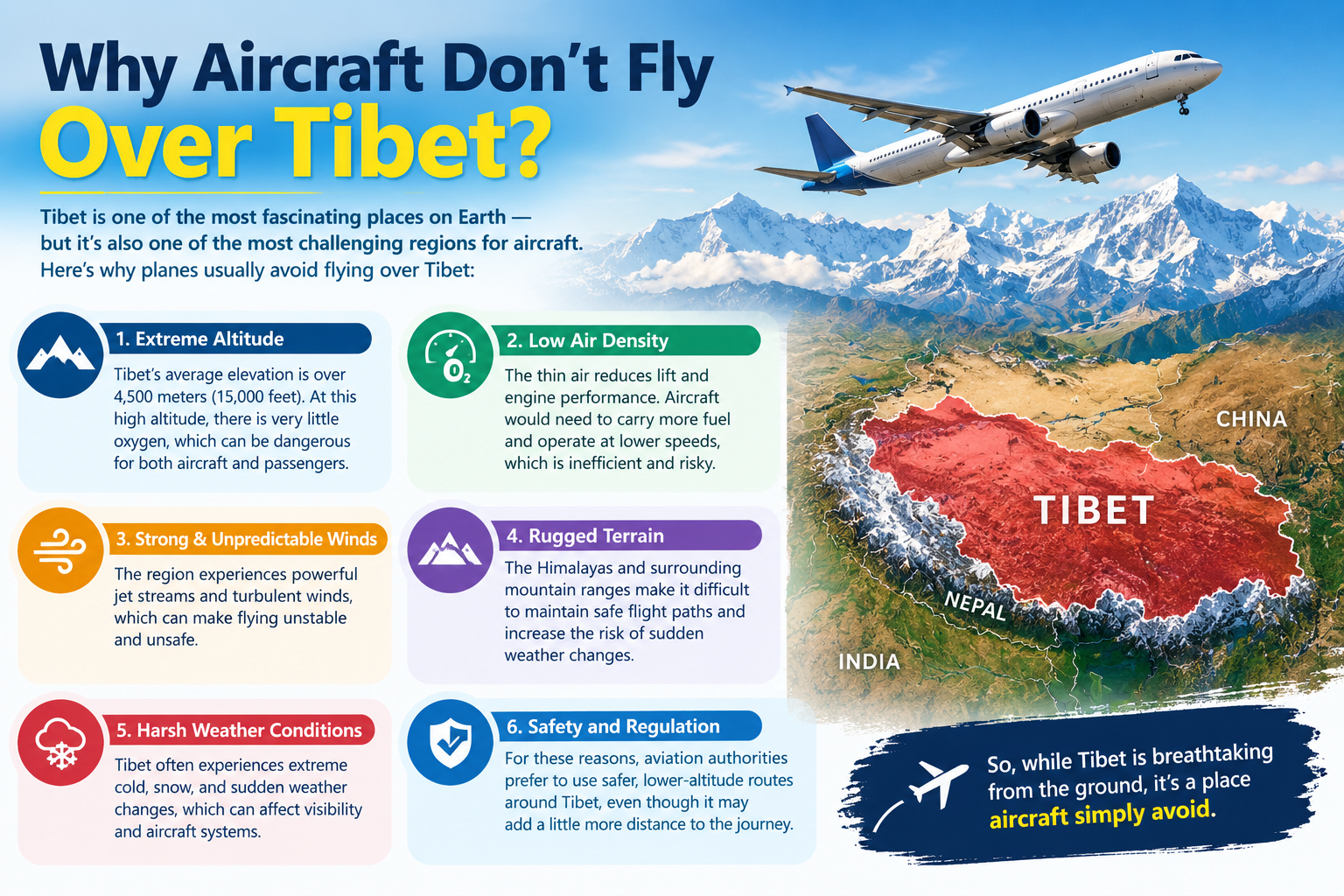
It’s not forbidden to fly over Tibet, but most airlines actively avoid it — even if it means a longer route. It’s about survival if something goes wrong.
1. It’s too high to survive an emergency
Almost all of Tibet averages 14,000-16,000 ft, with peaks over 26,000 ft.
If an aircraft loses cabin pressure, it must descend to 10,000 ft so passengers can breathe. Over Tibet, there is no 10,000 ft — you would crash into a mountain before you could get low enough.
Same for an engine failure on a twin-engine jet. On one engine, you slowly drift down. Over Tibet, you can’t stay above the mountains on one engine.
2. No place to land
Aviation rules (ETOPS / drift-down rules) require you to always be within ∼60-180 minutes of a suitable airport. The Tibetan Plateau is huge and has very few airports that can handle an airliner — Lhasa, Shigatse — and they are high-altitude airports themselves with short runways and unpredictable weather. So airlines would be unable to route there on many aircraft types.
3. The aircraft and engines don’t like it
• Very cold, very turbulent air. The jet stream and mountain wave turbulence over the Himalayas is brutal — can cause severe turbulence and clear-air turbulence with no warning.
• Navigation and communication gaps. Sparse radar coverage.
• High terrain makes emergency procedures very complex for pilots.
4. So what do they do instead?
They go around. Look at a flight map from Delhi to Beijing or Europe to South Asia — you’ll see a distinct hole over Tibet. They route over India, Nepal’s southern edge, or via the northern Silk Road corridors over lower terrain in Xinjiang where diversion airports like Urumqi, Kashgar exist.
Some aircraft _do_ overfly Tibet now — newer Airbus A330s, A350s, Boeing 787s/777s with better high-altitude drift-down performance and oxygen systems that allow special approval — but most carriers still choose to avoid it because the risk vs. 20 minutes of fuel saved isn’t worth it.