Flight Operations: The Precision Behind Every Safe Journey
September 21, 2026
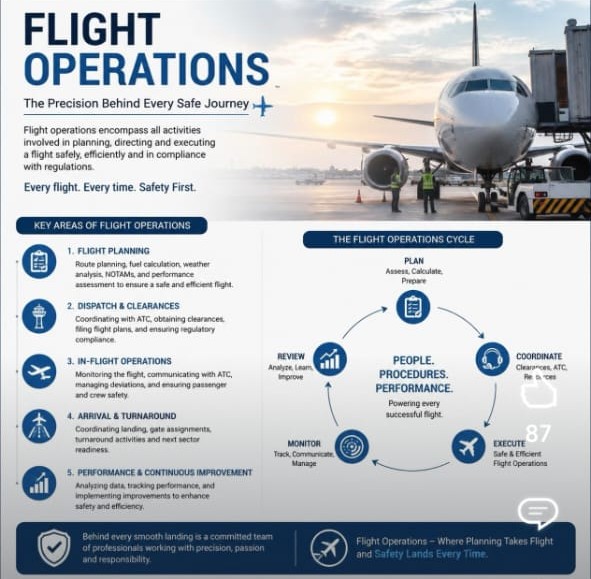
Every successful flight is the result of careful planning, precise coordination, and continuous monitoring. While passengers see only the aircraft taking off and landing, a highly skilled team works behind the scenes to ensure that every stage of the journey is safe, efficient, and compliant with aviation regulations.
Flight operations bring together flight dispatchers, pilots, air traffic controllers, cabin crew, ground staff, maintenance teams, airport authorities, and several other professionals. Their shared objective is simple: to move passengers and cargo safely from one destination to another. The Flight Operations Cycle
Flight operations follow a continuous cycle:
🛩️ Plan – Assess the route, aircraft, weather, fuel, and regulatory requirements.
🛩️ Coordinate – Communicate with air traffic control, airports, ground teams, and crew.
🛩️ Execute – Conduct the flight safely and efficiently.
🛩️ Monitor – Track the aircraft, weather, fuel, communication, and changing risks.
🛩️ Review – Analyse performance and apply lessons for future operations.
This cycle demonstrates that flight operations are not a single task. They are an ongoing process of preparation, execution, observation, and improvement.
People, Procedures, and Performance The success of flight operations depends on three essential elements: people, procedures, and performance.
People
Trained professionals are at the heart of aviation operations. Flight dispatchers, pilots, engineers, air traffic controllers, ramp staff, and customer service teams each contribute to flight safety.
Clear communication and teamwork are essential because aviation involves many departments working under time pressure.
Procedures
Standard operating procedures provide a structured method for completing tasks. They help personnel manage normal operations as well as unusual situations such as severe weather, technical problems, airport closures, or medical emergencies.
Following procedures consistently reduces the possibility of human error and supports effective coordination.
Performance
Operational performance is measured through safety, efficiency, punctuality, cost control, and service quality. A well-managed operation aims to achieve all of these goals without compromising safety.
In aviation, efficiency must always support safety—not replace it.
Safety in Flight Operations
Safety is the first priority in every phase of a flight. Strong safety management requires personnel to identify hazards, assess risks, and take preventive action.
Common operational hazards include:
🛩️ Foreign object debris on the ramp.
🛩️ Vehicle or equipment collisions.
🛩️ Aircraft jet blast and propeller hazards.
🛩️ Poor communication.
🛩️ Fatigue and workload pressure.
🛩️ Weather-related disruptions.
🛩️ Incorrect documentation.
🛩️ Inadequate baggage or cargo loading.
🛩️ Unauthorised access to restricted areas.
Safety reporting systems allow employees to report hazards and incidents without fear of unfair punishment. These reports help organisations identify weaknesses before they result in accidents.
The Importance of Communication
Communication connects every part of flight operations. A flight may involve information exchanged between the cockpit, operations control centre, air traffic control, airport management, ground handling, maintenance, and passenger service teams.
Good operational communication should be:
🛩️ Accurate.
🛩️ Brief and clear.
🛩️ Timely.
🛩️ Professional.
🛩️ Confirmed when necessary.
For example, when weather conditions deteriorate at the destination, the operations team must promptly inform the crew and assess suitable alternatives. Delayed or incomplete information can lead to poor decisions and unnecessary operational disruption.
Technology in Modern Flight Operations
Modern flight operations rely heavily on technology. Airline operations control centres use systems to monitor aircraft, crew schedules, weather, airport capacity, and flight disruptions.
Technology supports:
🛩️ Real-time aircraft tracking.
🛩️ Electronic flight planning.
🛩️ Weather monitoring.
🛩️ Digital NOTAM access.
🛩️ Crew and aircraft scheduling.
🛩️ Fuel optimisation.
🛩️ Maintenance coordination.
🛩️ Disruption management.
🛩️ Data-based performance analysis.
However, technology is only as effective as the people using it. Professional judgement, training, and proper procedures remain essential.
Conclusion
Behind every smooth landing is a committed team working with discipline, precision, and responsibility. Flight operations combine planning, coordination, communication, monitoring, and continuous improvement to create a safe and efficient journey.
Passengers may experience aviation as a simple process of checking in, boarding, flying, and arriving. In reality, every flight is supported by a complex operational system in which people, procedures, and technology work together.
Flight operations are therefore more than the movement of an aircraft. They represent the careful coordination and professional teamwork that make safe air travel possible—every flight, every time.
What Are Flight Operations?
Flight operations include all activities involved in planning, coordinating, monitoring, and completing a flight. These activities begin well before passengers board the aircraft and continue until the aircraft reaches its destination and completes its turnaround.
A flight operations team considers several important factors, including:
🛩️ Aircraft performance and serviceability.
🛩️ Weather conditions along the route.
🛩️ Air traffic restrictions and airport conditions.
🛩️ Fuel requirements and alternate airports.
🛩️ Passenger, baggage, and cargo loads.
🛩️ Crew availability and duty-time limitations.
🛩️ Applicable aviation rules and procedures.
The process demands accuracy because even a small error in planning or communication can affect safety, punctuality, and operational efficiency.
Key Areas of Flight Operations
1. Flight Planning
Flight planning is the foundation of every flight. It involves selecting a suitable route, calculating fuel requirements, reviewing weather conditions, checking navigation facilities, and identifying possible alternate airports.
Flight dispatchers and pilots work together to prepare the operational flight plan. The plan may include:
Departure and destination airports.
Planned route and cruising levels.
Estimated flight time.
Fuel required for the journey.
Weather forecasts and significant weather information.
NOTAMs affecting airports, runways, or routes.
Alternate airport requirements.
Aircraft weight and performance data.
Before departure, the flight crew reviews the plan and confirms that it meets operational and regulatory requirements.
2. Dispatch and Clearances
Flight dispatch involves coordinating with air traffic control, airport authorities, and other operational departments. The flight plan must be filed with the appropriate authorities, and the crew must receive the required clearances before departure.
This stage includes:
Filing the flight plan.
Obtaining air traffic control clearance.
Confirming departure slot information.
Coordinating with ground handling teams.
Verifying airport restrictions.
Ensuring that required documents are available.
Effective dispatch coordination helps prevent delays and ensures that all departments have the same operational information.
3. In-Flight Operations
Once the aircraft is airborne, flight operations continue through regular monitoring and communication. The flight crew maintains contact with air traffic control and manages the aircraft according to the approved flight plan.
During the flight, the operations team may monitor:
Aircraft position and progress.
Weather developments.
Air traffic congestion.
Fuel status.
Airport conditions at the destination.
Changes to the planned route.
Potential delays or diversions.
If conditions change, the flight dispatcher and crew may evaluate alternative routes, fuel options, holding requirements, or diversion airports. This cooperation between the cockpit and the operations control centre supports informed and timely decision-making.
4. Arrival and Turnaround
Arrival operations begin before the aircraft reaches its destination. The airport and ground teams prepare for parking, passenger disembarkation, baggage handling, catering, refuelling, cleaning, and boarding for the next sector.
A safe and efficient turnaround requires close coordination among:
Air traffic control.
Ramp agents.
Ground support equipment operators.
Cabin crew.
Maintenance personnel.
Fuel suppliers.
Catering and cleaning teams.
Passenger service staff.
During this stage, ramp safety is especially important. Personnel must remain alert to aircraft engines, vehicle movements, jet bridges, propellers, baggage equipment, and other hazards around the aircraft.
5. Performance and Continuous Improvement
Flight operations do not end when the aircraft arrives. Airlines review operational data to identify areas for improvement.
Important performance indicators may include:
On-time departure and arrival.
Flight delays and their causes.
Fuel consumption.
Diversions and cancellations.
Safety reports.
Baggage and ground-handling performance.
Aircraft utilization.
Passenger service issues.
By analysing this information, airlines can improve procedures, reduce repeated delays, enhance safety, and use resources more effectively.