Airspeed vs Groundspeed
August 05, 2026
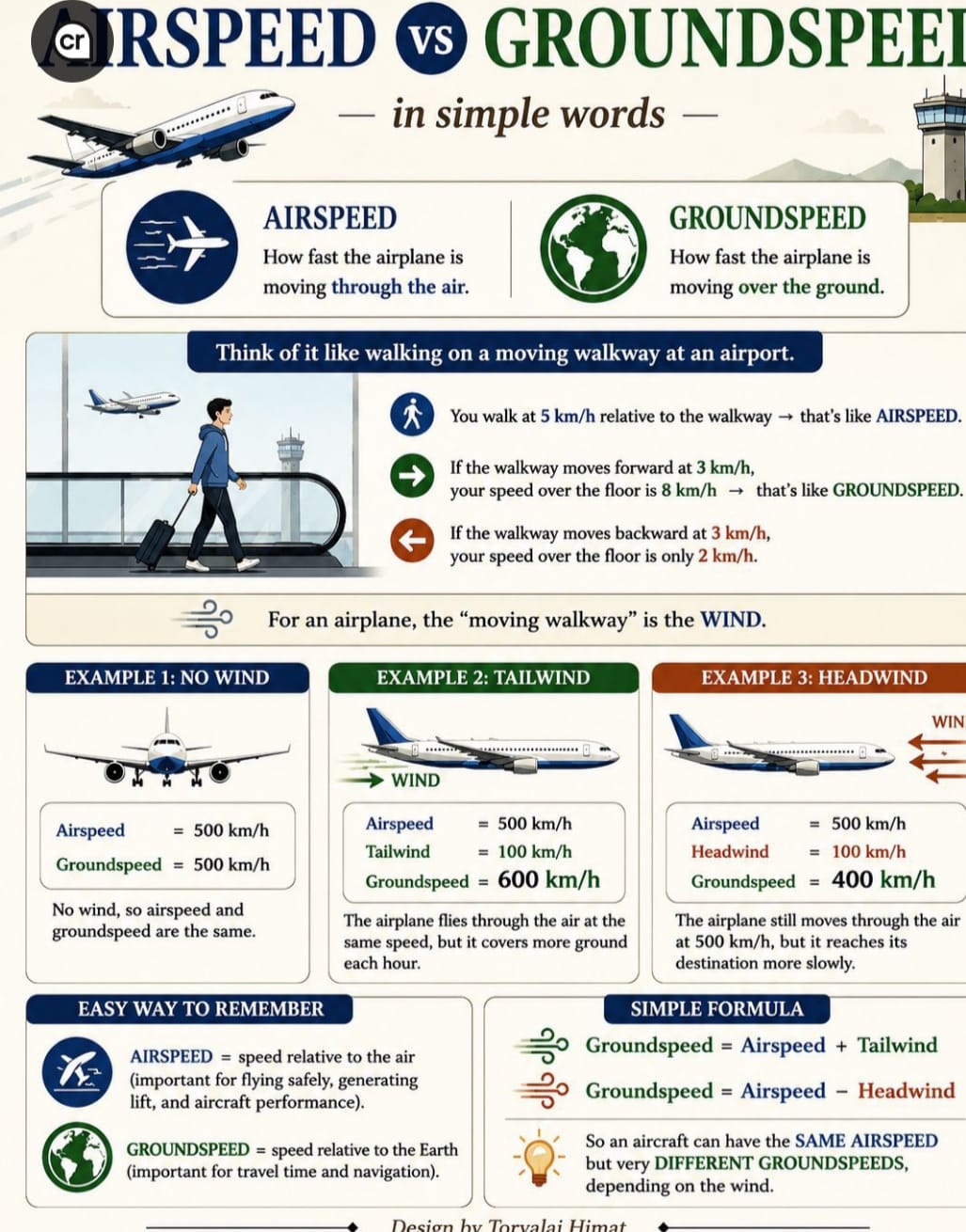
Airspeed is how fast an aircraft moves through the air, while groundspeed is how fast it moves over the earth’s surface. The difference matters because wind can make the aircraft’s speed over the ground faster or slower even when airspeed stays the same.
Simple Explanation
Think of an airport moving walkway. Your walking speed relative to the walkway is like airspeed, and your speed relative to the floor is like groundspeed. If the walkway moves with you, you travel faster over the floor; if it moves against you, you travel slower. For an aircraft, the “moving walkway” is the wind.
Why Airspeed Matters
Airspeed is important for flying safely because it affects lift, stall margin, takeoff roll, landing distance, and aircraft performance. Pilots use airspeed for control and performance decisions, especially during climb, approach, and landing. Groundspeed is more important for navigation and estimating how long the journey will take. It tells you how quickly the aircraft is actually covering distance across the ground.
Wind Effect
With no wind, airspeed and groundspeed are the same.
With a tailwind, groundspeed becomes higher than airspeed. Example: if an aircraft’s airspeed is 500 km/h and it has a 100 km/h tailwind, the groundspeed becomes 600 km/h. If the same aircraft has a 100 km/h headwind, the groundspeed becomes 400 km/h.
Easy Formula
Groundspeed = Airspeed + Tailwind
Groundspeed = Airspeed – Headwind
With a headwind, groundspeed becomes lower than airspeed. A plane can fly with the same airspeed on two different days and still have very different groundspeeds depending on wind conditions. Conclusion
Airspeed is about flying safely through the air, while groundspeed is about moving over the earth. In aviation, both matter, but for different reasons: one for performance, the other for time and navigation