AIRCRAFT LIGHTS
July 11, 2026
Introduction
Aircraft exterior lights serve three main purposes: make the aircraft visible to others, improve pilot visual reference during critical phases of flight, and provide illumination for ground or inspection tasks. These lights are standardized in function across transport and general aviation, though exact installation and procedures vary by aircraft type and operator manuals.
Types of exterior lights and their purpose
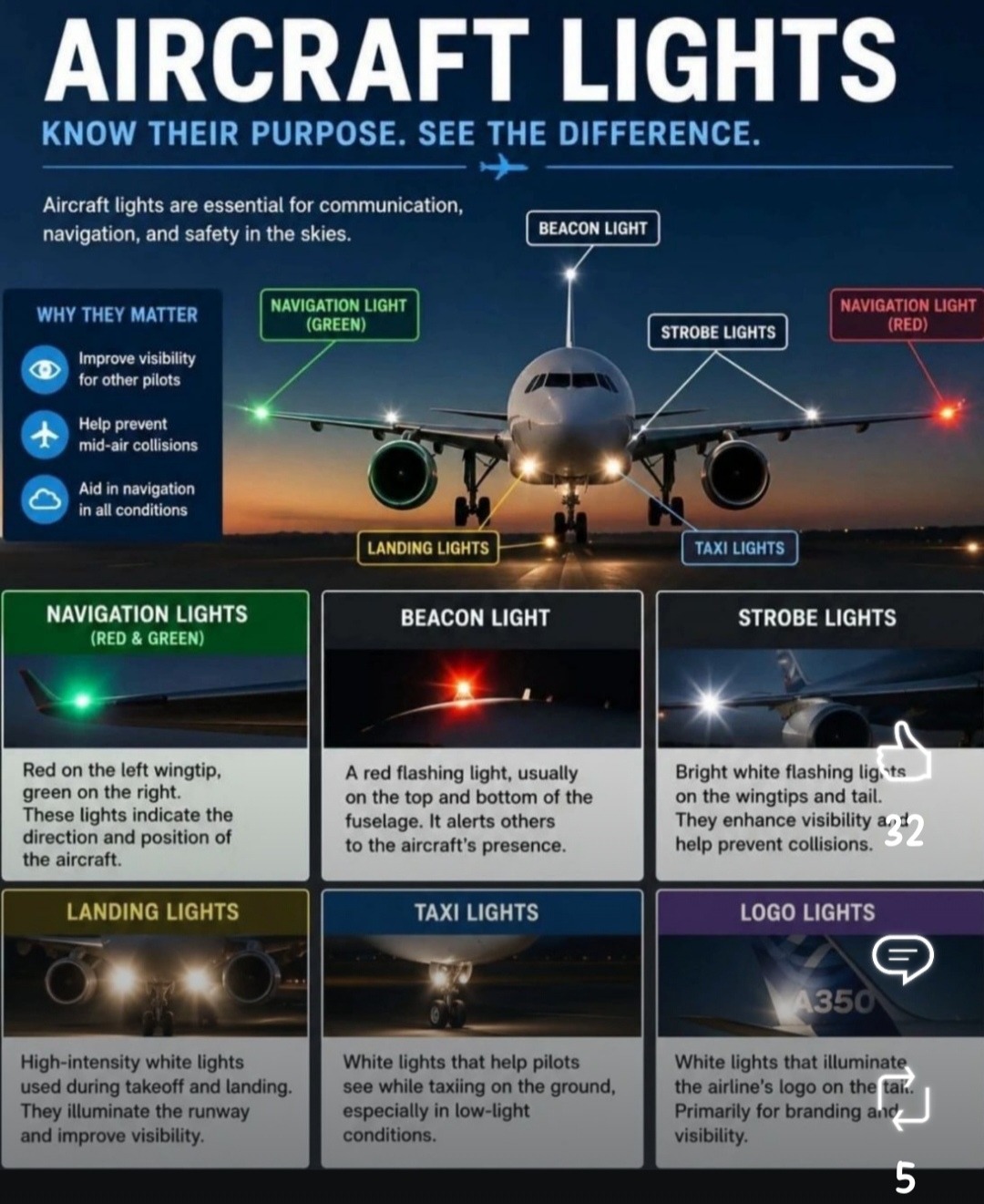
Navigation / Position lights: Red on the left wingtip, green on the right wingtip and white at the tail; they show aircraft orientation and relative heading to other pilots and are the only ICAO-mandated lights for all aircraft.
Anti-collision beacon (red): Flashing red lights usually on top and bottom of the fuselage, turned on before engine start to warn ground crew and others that engines/propellers may move.
Strobe lights (white): High-intensity flashing white lights on wingtips and often tail, used to increase visibility especially when entering or on the active runway for takeoff; typically switched off when parked or in cloud to avoid blinding other crews.
Landing lights: Very high-intensity white lights mounted on wings, gear or fuselage; used for runway illumination during takeoff and landing and also to make the aircraft more conspicuous to other traffic. Operators often switch them on for takeoff and below 10,000 ft on approach per many SOPs.
Taxi and runway turnoff lights: Medium-intensity lights (often on nose gear or wing roots) used for ground maneuvering and for illuminating runway exit areas; taxi lights are used while taxiing and usually turned off when stopped in front of marshallers to avoid glare.
Wing inspection / ice inspection lights: Aimed to illuminate the wing leading edge and engine pylons to permit visual checks and detect ice accretion at night.
Logo lights: Low-intensity lights aimed at the vertical tail to illuminate the airline logo for identification and branding at night.
Special-purpose lights (search, formation): Used on military, SAR, or enforcement aircraft for specific missions; not typical on airliners.
Operational use and standard procedures
Beacon on before engine start, off after shutdown — this is a common ground-safety practice to warn personnel of imminent engine/propeller movement.
Strobes on when entering/clearing active runway; many systems use a weight-on-wheels (WOW) switch or an AUTO position to manage this automatically.
Landing lights used for takeoff/landing and commonly switched off above certain altitudes (e.g., climb through 10,000 ft) where SOPs recommend conserving lamp life and avoiding unnecessary glare, then re‑selected on descent below the same altitude.
Taxi/runway turnoff lights used only for ground operations to avoid dazzling other crews; turnoff lights assist with tight turns at higher taxi speeds.
Safety, human factors, and hazards
High-intensity lights (strobes, landing) can cause flash blindness for ground personnel and other flight crews; procedures require switching them off when parked or near marshalling personnel.
Misuse or incorrect light configuration can cause confusion in ATC or among other pilots (e.g., strobes on while taxiing across an active runway can be misinterpreted). Many regulators and operators therefore specify light usage in SOPs.
External light failures have MEL implications; some lights (navigation) are regulatory, while others may be deferred to MEL with restrictions. Check the aircraft MEL and operator AOM for allowed dispatch conditions.
Practical tips for ground ops and tower coordination
For ground-handling crews: treat a red beacon illuminated as “engines may be running or starting” and maintain clearances until beacon off.
For ATC and tower: pilots often use landing lights and strobes as a visual acknowledgement of runway entry/takeoff intentions; be aware that some crews rely on SOP timing (e.g., landing lights on when entering runway).
Night ramp parking: request pilots to turn taxi/landing lights off when stopped near marshallers and avoid use of strobes in congested ramp areas to reduce glare for ground teams.
Example: A typical A320 light-flow on departure (illustrative)
Before engine start: beacon ON to warn ground crew.
Taxi: beacon stays ON, taxi lights ON; strobes typically OFF until entering runway.
On entering active runway: strobes ON, landing lights ON, takeoff performed. After liftoff and cleaning up, landing lights may be turned OFF above 10,000 ft per SOP.